INDEX DIGGA PRO
The Nasdaq, on both of its tapes — and the one toggle that makes a setup count twice.
INDEX DIGGA PRO with ZONE DIGGA and REGIME DIGGA beside it: €20/mo, or €168/yr billed annually. 10-day free trial.
The index vehicle of the family, and the first one built on a different engine: a break of structure defines a leg, the entry is a limit at an order block inside that leg’s retracement, and the stop sits beyond the block. Three cells shipped, and the symbol decides which runs — there is no lane dropdown, because a player with tuning knobs is a bench with a marketing name.
What it was measured at
Three trading years, September 2023 to September 2026, on the owner’s own tester, 1 % risk per trade, commission included.
| Cell | R by trading year | Trades, all three | PF, all three | Max drawdown, all three |
|---|---|---|---|---|
| Nasdaq futures · 15m | +10.2 / +1.0 / +45.4 | 453 | 1.21 | −16.0 R |
| Nasdaq CFD · 15m | −6.5 / +3.5 / +42.1 | 472 | 1.13 | −24.3 R |
| Spot gold · 15m | +34.6 / −0.5 / +18.8 | — | — | — |
Only the first column is per year. Trades, profit factor and drawdown are the whole three-year run — max drawdown in particular is the single worst peak-to-trough of that run, which may sit inside one year or straddle two, and never decomposes into the figures beside it. At 1 % risk the CFD cell’s −24.3 R is a 24 % account drawdown; it wants a fraction of that sizing. The gold row carries no aggregate because none can be verified over this window.
The window starts where it does by choice, and that choice flatters the table. The 2022-23 year was measured — +5.5, +3.7 and −12.0 R — and dropping it lifts the futures cell from PF 1.19 to 1.21 and its worst drawdown from −24.0 R to −16.0 R. Add it back if you want the four-year picture.
Read the rows, not the totals. Nine measured years sit in that table; six are ordinary and three are the years. Take +45.4, +42.1 and +34.6 out and what is left is a scratch. That is the shape of this edge, not a flaw in it, and it is the whole instruction for using it: size for the six, not the three. The gold cell is the smallest of the three and the only one with a losing year worth twelve times the unit risk — it belongs in a book at a size that says so.
The finding: the other feed
FX:NAS100 and the CME contract trade the same index at slightly different prices, on tapes that do not open and close together. A setup that forms on both is a different thing from a setup that forms on one. Measured across three feeds, nine of nine combinations improved — and what it buys is drawdown rather than profit: on the futures cell the total barely moves while the ride roughly halves.
It ships off by default, it needs the other symbol on your TradingView plan, and it is ignored on gold — the same rule was measured on the metal and loses there. A finding does not get to travel to an instrument that refused it.
What is not in it
Two lanes run. Two more were built to specification, measured, and earned no cell: they live in the bench so anyone can re-run the refutation rather than take it on trust. The celebrated number of one of them turned out to be a fill artefact — a stop that filled after price had already passed it — and the honest version dies at real commission. That is written down on the product page rather than quietly dropped.
What you get
- Three measured cells, picked by the symbol — Nasdaq futures, Nasdaq CFD, spot gold
- No lane dropdown and no preset selector — open the chart and its cell runs
- Require a setup to stand on BOTH Nasdaq tapes before a limit rests
- Trade levels on every setup — entry, stop, target and a lot size for your account
- A table that says which cell is running and whether a pasted preset actually loaded
- Any other symbol pastes in as a preset string, checksummed end to end
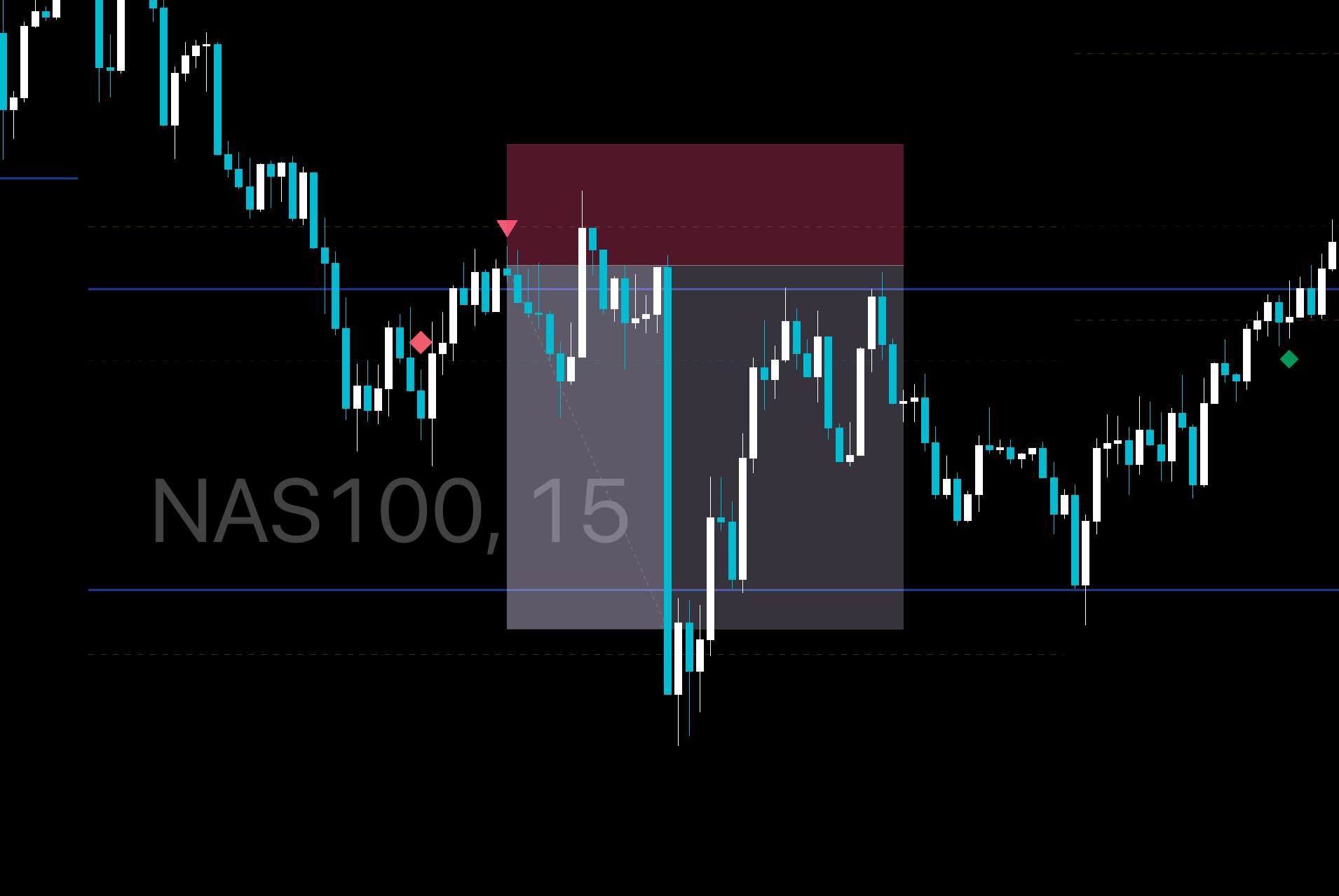
What it did, and what it did not.
Measured differently from the gold and crypto sleeves, and the difference matters: consecutive trading years on the owner's own tester, at 1% risk with commission in, in R rather than in account currency. There is no holdout column here because there is no holdout window — and inventing one would be exactly the failure the ledger exists to prevent.
| R by trading year | All three years together | |||||
|---|---|---|---|---|---|---|
| Cell | 23-24 | 24-25 | 25-26 | Total | PF | Max DD |
| Nasdaq futures · 15m 3 of 3 positive | 10.2 | 1.0 | 45.4 | +56.7 R | 1.21 | -16.0 R |
| Nasdaq futures · 15m, both tapes agreeing 4 of 4 positive | — | — | — | +61.4 R | 1.27 | -13.0 R |
| Nasdaq CFD · 15m 2 of 3 positive | -6.5 | 3.5 | 42.1 | +39.2 R | 1.13 | -24.3 R |
| Spot gold CFD · 15m 2 of 3 positive | 34.6 | -0.5 | 18.8 | — | — | — |
| Nasdaq futures · 5m 2 of 3 positive | 1.6 | -2.6 | 33.8 | +32.9 R | 1.21 | -15.0 R |
The window starts at September 2023 by choice, not by absence of data, and that choice flatters the table: 2022-23 was the weakest year in every cell (+5.5, +3.7 and −12.0 R) and removing it takes the futures cell from PF 1.19 to 1.21 and its worst drawdown from −24.0 R to −16.0 R. Totals are measured over the three years, never summed from the columns beside them — a trade spanning a year boundary is counted in neither.
What changed, version by version.
All three notes so far for INDEX DIGGA PRO, as posted to subscribers. Open one to read it in full.
INDEX DIGGA PRO v1.1 — a visuals release, and not one trade moves
INDEX DIGGA PRO v1.1 — a visuals release, and not one trade moves
Every cell, every lane and every measured number is exactly what v1.0 shipped. What changed is what you see — and what you are asked to set.
The background is read, not declared. The “dark chart background” tick is gone. You could set it to disagree with your own screen, and a palette that disagrees with the screen is the one kind you cannot see. v1.1 measures your background’s luma and picks for itself.
Colour now tells you the period: blue is the week, orange is the day. Three things were drawn in near-identical blues, so a line could not be traced back to the switch that drew it. A closed week’s value area was repainted into last week’s colour and left on the chart — two blue sets, same week, nearly the same prices, different switches. Turning off “last week’s” left blue lines standing, and the thick blue line nobody could name was the frozen developing VAH.
Now a closed week keeps its own identity, the day POC is orange, and the week’s three objects have three switches: the projection into this week, the past weeks’ footprint, and the week now running.
Spent lines fade by a step, not to a flat value — the opacity slider in each colour is now the control, where a fixed transparency used to override it.
The daily levels are gone — the green lines, the untested pivots, and the proximity guard with its four settings. The guard shipped off and measured negative, so nothing you traded depended on it. Yesterday’s high and low are still tracked: the rule that pauses a direction after a close beyond one of them is a different rule, measured on its own, and it stays.
Preset strings: re-export. Seven carried settings were removed, so a string holds 124 where v1.0 held 131. A v1.0 string is refused whole rather than half-applied — the count and the checksum exist for exactly this. Mint a new one from PRO ULTRA v1.1.
INDEX DIGGA ver1.0 — the Nasdaq bundle, and the year that carries it (1/2)
INDEX DIGGA ver1.0 — the Nasdaq bundle, and the year that carries it (1/2)
The third vehicle. $$$ INDEX DIGGA PRO $$$ is the player; $$$ INDEX DIGGA PRO ULTRA $$$ is the bench that mints its presets. Both on the 15-minute chart, both invite-only.
Three cells, picked by the symbol. No lane dropdown and no preset selector in the player: open MNQ1! and the futures cell runs, NAS100 and the CFD cell runs, XAUUSD and the gold cell runs. Four trading years to September 2026, the owner’s own tester, 1 % risk, commission in:
MNQ / NQ futures   +5.5 / +10.2 / +1.0 / +45.4 R   4 of 4 · 597 trades · PF 1.19
NAS100 / US100     +3.7 /  -6.5 / +3.5 / +42.1 R   3 of 4 · 647 trades · PF 1.11
XAUUSD gold CFD   -12.0 / +34.6 /  -0.5 / +18.8 R  2 of 4 · 347 trades · PF 1.15
Read the rows, not the totals. Twelve measured years; nine are ordinary and three are the years. Take +45.4, +42.1 and +34.6 out and what is left is a scratch. That is the same convexity every vehicle here has shown, and it is the whole instruction for using this one: size for the nine, not the three.
🔗 The other feed — the finding of this campaign. FX:NAS100 and the CME contract trade the same index at slightly different prices. Require a setup to appear on both before a limit rests, and across three feeds nine of nine combinations improved:
MNQ1!    +61.4 R vs +62.1 plain   drawdown 13.0 vs 24.0   PF 1.27 vs 1.19
NAS100   +61.8 R vs +48.8 plain   drawdown 26.2 vs 36.9   PF 1.21
What it buys is drawdown, not profit — the total barely moves and the ride halves. Off by default; it needs the counterpart symbol on your plan; and it is ignored on gold, where the same rule was measured and loses. A Nasdaq finding does not get to travel to an instrument that refused it.
Gold futures have no cell — MGC and GC are left empty rather than handed the spot numbers.
INDEX DIGGA ver1.0 (2/2) — what is not in it, and two bugs worth naming
INDEX DIGGA ver1.0 (2/2) — what is not in it, and two bugs worth naming
Two lanes in the player, four in the bench. 👌 Regular and 🔥 Scalps run; Scalps only on the CFD, because futures measured and refused it. 🧠 PSYCHO and 🌅 DAILY were built, measured, and neither earned a cell — they stay in the bench so the refutation can be re-run rather than taken on trust. PSYCHO’s celebrated Nasdaq number was a fill artefact: a stop that filled after price had already passed it. The honest version is +0.05 R a trade and dies at real commission.
The player has no tuning. Every order-block, volume-profile, regime, stop and lane parameter is gone: what is left is the terms tick, the clock, risk and account, the link toggle, markers, visuals, alerts and the preset field. A player with tuning knobs is a bench with a marketing name.
🌐 Preset strings, the GOLD shape. One-line PD2 strings, minted by PRO ULTRA, checksummed end to end, and the string always wins over the cell — on any symbol, including one with no cell at all. Fourteen settings in a string (the EMA lengths and every timeframe) are carried and verified but not applied: Pine will not take a length that comes as text. A preset that fails does so in silence, so the table bottom left names which cell is running, what a pasted string did, and whether the feeds are linked.
Two bugs, found against the owner’s own charts, now permanent rules of the bench:
The naked first bar. Exits were placed only after a fill was seen, so the first bar of every trade ran without a stop — eight of sixty-nine DAILY trades cost 1.5 to 7.8 R instead of 1 R. Exits now go on the arming bar, and it cost the published MNQ table 27 R: +89.5 became +62.1. The lower number is the honest one.
Two lanes filling in one bar. Only one could be given its exits; the other sat open for 16,000 bars and the margin calls took a test account to −99.9 %. One position at a time is now enforced by the book.